Rent-to-Own Contract Red Flags: What to Watch For
Spot rent to own contract red flags before you sign. Learn which clauses put you at risk and what a fair agreement actually looks like.
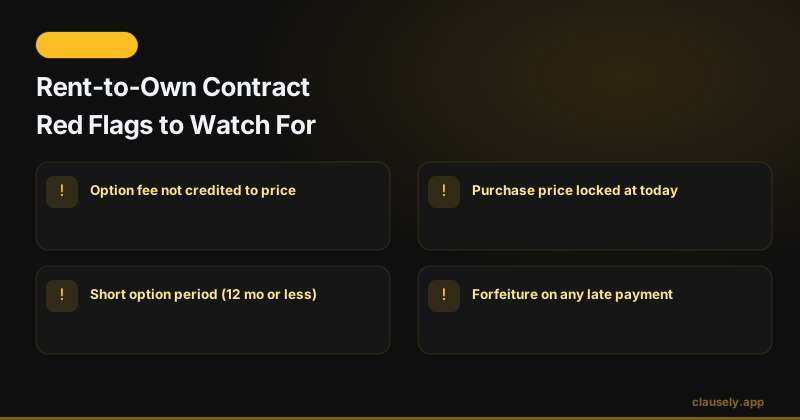
Maria found the listing on a Tuesday. A three-bedroom house in the neighborhood she had been watching for two years. The seller was offering a rent-to-own deal: move in now, apply a portion of rent toward the purchase price, and close in two years when her credit would be ready. It sounded like the bridge she needed. Then the contract arrived. It was twelve pages long. The option fee was nonrefundable. The purchase price was locked at today's value with no appraisal required at closing. A single late payment would wipe out every dollar of rent credit she had accumulated. The deal that looked like a path to ownership was structured to keep her renting indefinitely while protecting the seller at every turn.
Rent-to-own agreements can be a legitimate path to homeownership. They can also be structured to fail. The difference is almost always in the contract.
Quick Red Flag Summary
Before reading further, here is a snapshot of the most common problems and how serious each one is:
| Red Flag | Severity | What It Means |
|---|---|---|
| No option fee credited toward purchase price | High | You are paying for the right to buy but the money does not reduce what you owe |
| Purchase price set at today's value, not market value at closing | High | You could be overpaying significantly by the time you exercise the option |
| Short option period (12 months or less) | High | Not enough time to arrange financing or repair credit |
| Maintenance obligations that belong on the seller | Medium | You are paying to maintain property you do not yet own |
| No appraisal requirement before closing | High | No protection if property value drops or was inflated |
| Forfeiture of all rent credits on late payment | High | One missed payment erases years of credit accumulation |
| Seller can exit the agreement with minimal notice | High | The option is one-sided |
| No title or lien check requirement | High | You could be buying into a property with encumbrances |
If you see three or more of these in a single contract, treat that as a serious warning. If you see all of them, walk away.
Red Flag 1: Option Fee With No Credit Toward Purchase
Severity: High
Most rent-to-own agreements require an upfront option fee. This is the payment that gives you the legal right to purchase the property later. Option fees typically run between 1% and 5% of the purchase price.
The problem arises when the contract states that this fee is nonrefundable and does not count toward the purchase price. You are paying thousands of dollars for the right to buy a house, and none of it reduces what you owe.
A fair agreement credits the option fee toward the purchase price at closing. A one-sided agreement treats it as pure income for the seller regardless of whether the sale ever happens.
Look for language that says the option consideration "shall be credited toward the purchase price at closing." If you do not see that language, ask for it explicitly. If the seller refuses, that tells you something about how this deal is structured.
You can use Clausely's AI contract review to flag nonrefundable fee clauses in any rent-to-own agreement before you commit.
Red Flag 2: Purchase Price Locked at Today's Value
Severity: High
In a standard rent-to-own agreement, the purchase price is set at signing. That means if you sign today and plan to close in two years, the price you pay in two years was determined today.
This structure can work in your favor if property values rise. You locked in a lower price. It can hurt you if the seller set the price above current market value anticipating appreciation that does not materialize, or if the market shifts in ways that leave you paying more than the home is worth at closing.
The real danger is when the contract has no appraisal requirement. Without one, you have no independent verification that the locked price was reasonable when set, and no protection if the home was overvalued from the start.
Some agreements include a formula for price adjustment. Others peg the price to an independent appraisal conducted at or near the closing date. Either approach gives you more protection than a fixed number chosen by the seller.
The Consumer Financial Protection Bureau has guidance on rent-to-own agreements that covers how purchase prices are typically structured and what protections buyers should expect.
Red Flag 3: Option Period of 12 Months or Less
Severity: High
The option period is the window you have to exercise your right to buy. If it expires without you closing, you typically lose the option fee and any rent credits you have accumulated.
Twelve months is not enough time for most people in a rent-to-own situation. If you are using this structure because your credit needs work, twelve months is rarely enough to meaningfully improve a credit score and qualify for a mortgage. If you need to save additional funds for a down payment, one year moves fast.
A realistic option period is 24 to 36 months. That gives you time to repair credit, save money, shop for lenders, and actually complete the mortgage process, which can take 60 to 90 days on its own.
Short option periods benefit sellers. If you cannot close in time, they keep your option fee, keep your rent credits, and can repeat the process with the next tenant. Be skeptical of any agreement that gives you less than two years.
Red Flag 4: Maintenance Obligations That Should Belong to the Seller
Severity: Medium
Some rent-to-own contracts shift major maintenance responsibilities to the tenant-buyer. This might include HVAC servicing, roof repairs, plumbing, or structural issues.
The logic sellers often use is that you are buying the home, so you should care for it. The problem is that you do not own the home yet. You have an option to buy it. If you spend $8,000 on a new roof during your option period and then cannot qualify for a mortgage, you have improved a home you never ended up owning.
Read the maintenance section carefully. Know exactly which repairs you are responsible for and which remain with the seller. A reasonable agreement keeps major structural and system repairs with the seller while the tenant-buyer handles routine upkeep.
If the contract assigns all maintenance to you with no ceiling on cost, negotiate a cap or a clear division of responsibility before signing.
Red Flag 5: No Appraisal Requirement Before Closing
Severity: High
An independent appraisal protects you from overpaying. It also protects your lender, which is why most mortgage companies require one anyway. But some rent-to-own contracts are structured to bypass this step or make it difficult.
Watch for language that locks in a purchase price as "final and non-negotiable regardless of appraisal." This means if an independent appraiser values the home at less than the contract price, you are still contractually obligated to pay the higher amount. Most lenders will not fund a mortgage above the appraised value, which means you would need to cover the gap in cash or walk away and lose your credits.
A fair agreement either pegs the purchase price to a closing-date appraisal or includes a provision that lets you renegotiate if the appraisal comes in below the contract price. If neither protection exists, you are carrying significant risk.
Red Flag 6: Forfeiture of All Rent Credits on Late Payment
Severity: High
This is one of the most punishing clauses in a bad rent-to-own contract. It works like this: every month you pay rent on time, a portion of that payment is credited toward your future purchase. Miss one payment, or pay even one day late, and every dollar of accumulated credit is gone.
Two years of on-time payments can translate to thousands of dollars in credited funds. A single late payment, even one caused by a banking error or a lost check, can wipe it all out.
Look for this clause carefully. It is sometimes buried in a section about payment terms or default remedies rather than in the rent credit section.
A reasonable agreement might include a grace period for late payments, a cure period that lets you make up a missed payment without losing all credits, or a forfeiture cap that limits how much credit you can lose in any single default event.
If the contract says something like "tenant-buyer forfeits all accumulated rent credits upon any default," that is a red flag worth flagging immediately.
Red Flag 7: Seller Can Exit With Minimal Notice
Severity: High
The option in a rent-to-own agreement is usually one-sided by design: you have the right to buy, but you are not obligated to. The seller, however, is generally obligated to sell if you exercise that option.
But some contracts include exit clauses that let the seller terminate the agreement under broad conditions. This might be triggered by a certain notice period, a change in the seller's circumstances, or vague language about the seller "needing to sell" the property.
If the seller can exit with 30 days' notice, your option is effectively worthless. You could spend two years building rent credits, improving your credit score, and planning to close, only to find out the seller terminated the agreement months before you were ready to buy.
Sellers do have legitimate reasons to include exit rights in some cases, such as a tenant's serious default. But those reasons should be specific and limited. Watch for broad language that gives the seller wide latitude to back out.
Red Flag 8: No Title or Lien Check Requirement
Severity: High
Before you exercise a purchase option, you need to know the property is actually free to sell. That means a title search to confirm there are no outstanding liens, encumbrances, or ownership disputes.
Some rent-to-own contracts do not require a title check at any point. You could spend two years renting and accumulating credits toward a home that has a mechanics lien, an unpaid tax bill, or a dispute from an ex-spouse who has partial ownership rights.
A clean title is a basic requirement for any real estate transaction. Your agreement should explicitly require a title search and title insurance as conditions of closing. If it does not, you should insist these be added.
HUD provides tenant rights information that covers what protections buyers and renters are entitled to under federal guidelines.
The Option Fee vs. Rent Credit Structure
These two things are often confused, and understanding the difference matters.
The option fee is what you pay upfront for the right to buy. It is typically nonrefundable if you choose not to buy or cannot close in time.
Rent credits are the portion of your monthly rent that gets set aside and applied toward the purchase. Not all rent goes to credit. A typical arrangement might credit 15% to 25% of each monthly payment.
In a fair contract, both the option fee and accumulated rent credits apply toward the purchase price at closing. In a predatory contract, neither does.
Run the math before you sign. If you are paying $1,500 per month and 20% goes to credit, that is $300 per month. Over 24 months, that is $7,200. That $7,200 should reduce your purchase price at closing. If the contract does not say that explicitly, ask why.
You can review the key clauses in any rent-to-own agreement using the Clausely contract review tool, which is designed to surface exactly these kinds of one-sided provisions.
Purchase Price Lock-in Risk
The locked purchase price issue deserves more attention than most buyers give it.
Real estate markets move. A home worth $350,000 today might be worth $380,000 in two years, or $320,000. If you locked in at $350,000 and the market drops, you are still obligated to pay $350,000.
Some sellers price rent-to-own homes above current market value, knowing that buyers in this situation are often willing to accept a higher price in exchange for time. By the time you are ready to close, the home may be worth exactly what you agreed to pay, but only because the market caught up to the seller's original ask.
There is no universal answer to how purchase prices should be set in rent-to-own deals. Some buyers prefer certainty. Others prefer a price pegged to a future appraisal. What matters is that you understand the structure and the risk before you commit.
If market values concern you, consider negotiating a price that is based on an independent appraisal conducted within 60 days of closing rather than a number set at signing.
Maintenance Responsibility Allocation
State law varies significantly on what maintenance obligations can be shifted to a tenant-buyer. Cornell Law's overview of landlord-tenant law explains the baseline protections tenants typically retain even in lease-option arrangements.
In most states, landlords are required to maintain habitable conditions regardless of what a contract says. But "habitable" is a floor, not a ceiling. A contract can still shift expensive elective repairs to you even while the seller remains legally obligated to maintain basic habitability.
Before you accept broad maintenance obligations, get specific. Ask for a list of every repair category the contract assigns to you. Know what that could cost. A single HVAC replacement can run $8,000 to $15,000. A roof can run $12,000 to $25,000. If you are responsible for those costs on a home you do not yet own, factor that into your analysis of whether this deal makes financial sense.
Financing Contingency Importance
Most buyers in rent-to-own arrangements intend to use a mortgage to purchase the home at the end of the option period. But mortgage qualification is not guaranteed, and a lot can change in two years.
A financing contingency protects you if you cannot secure a mortgage when the time comes. Without one, failure to close means losing your option fee and rent credits.
Look for language that gives you a defined exit if you cannot obtain financing by a certain date. Some contracts include this as a standard clause. Others treat failure to close as a default and enforce full forfeiture.
If a financing contingency is not included, try to negotiate one in. A reasonable seller who genuinely wants the sale to close should be willing to include at least a 30 to 45 day financing period with a defined exit if funding falls through.
What Happens If You Cannot Close
Understanding the default and forfeiture terms is critical before you sign.
Most rent-to-own contracts treat failure to exercise the option as a nondefault event. You simply do not buy. You move out. You lose the option fee. Whether you lose the rent credits depends on the specific contract language.
But failure to close after exercising the option is a different matter. If you commit to purchase and then cannot fund the transaction, you may face claims for the seller's carrying costs, legal fees, and other damages on top of losing your option fee and credits.
Read the default section carefully. Know exactly what triggers a default, what the seller can claim if you default, and whether there is any cure period before remedies are enforced.
The relevant section often uses language like "time is of the essence," which means deadlines are strict and missing them by even a day can constitute a default. If you see that phrase, take it seriously.
For additional context on how to spot problematic clauses in any contract, see our guide on 7 clauses to check before signing any contract and our breakdown of what to check before signing a lease.
If you want to understand specific contract language, our termination clause glossary entry covers how exit rights typically work in lease and purchase agreements.
Clausely is also available for renters who need to review lease agreements and spot one-sided terms before signing.
Frequently Asked Questions
What are the biggest red flags in a rent-to-own contract?
The most serious red flags are: an option fee that does not count toward the purchase price, forfeiture of all rent credits on any late payment, a short option period of 12 months or less, no requirement for an independent appraisal before closing, and seller exit rights that are broad or vaguely defined. Any one of these can turn a rent-to-own deal into a financial trap.
Is rent-to-own a good idea?
It depends on the contract. Rent-to-own can be a legitimate bridge to homeownership for buyers who need time to improve their credit or save for a down payment. But the structure puts most of the risk on the buyer by default. A well-negotiated contract with fair credit terms, a realistic option period, and clear default protections can work. A one-sided contract designed to capture fees and forfeited credits is not a path to ownership; it is a mechanism for repeated tenant turnover that benefits the seller.
What happens to rent credits if I do not buy?
In most rent-to-own agreements, accumulated rent credits are forfeited if you do not exercise the purchase option before the deadline. The exact terms depend on your contract. Some agreements allow for a partial refund of credits in specific circumstances. Others treat all accumulated credits as nonrefundable regardless of the reason for not buying. Read the forfeiture terms before you sign and make sure you understand exactly what you stand to lose if the deal does not close.
Do I need a lawyer to review a rent-to-own contract?
A lawyer familiar with real estate contracts in your state can review the terms, flag risks specific to local law, and negotiate changes on your behalf. That is worth the cost, especially for a transaction this significant. At minimum, use an AI contract review tool like Clausely to identify one-sided clauses before you decide whether to involve a lawyer. Knowing which specific terms are problematic will help you ask better questions and make the legal review more efficient.
Read the guide, then move into the real workflow, pricing, audience page, and glossary that support the next decision.
This article is for informational purposes only and does not constitute legal advice. For high-stakes agreements, consult a qualified attorney.
Got a contract to review?
Upload it and get full AI contract review in under a minute. Free.
Analyze My Contract