Contractor vs Employee Contract: What the Difference Means for You
A contractor vs employee contract determines taxes, benefits, IP ownership, and legal rights. Here's what to look for in each.
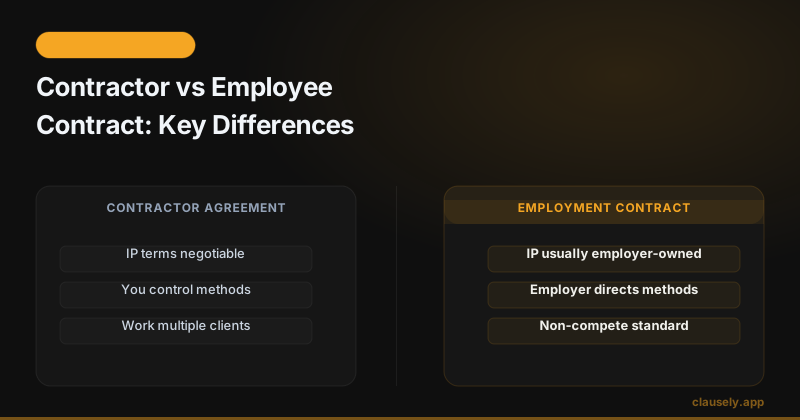
TL;DR: A contractor vs employee contract is not just a title difference. It determines who pays taxes, who owns your work, whether you get benefits, and how much legal protection you have if things go wrong. Getting the classification wrong carries real legal and financial consequences for both sides. Read what to look for before you sign anything.
When someone hands you a contract, one of the first things to understand is what type of agreement you are actually looking at. Is this an independent contractor agreement or an employment contract? The answer shapes almost everything about your working relationship: how your taxes are handled, whether you get benefits, who owns the work you produce, and what happens if the relationship ends.
This is not a paperwork formality. Misclassification costs real money and creates real legal exposure. The IRS pursues misclassification cases aggressively. States like California have their own enforcement regimes. And the person who is misclassified often has no idea until they file their taxes, get denied unemployment benefits, or realize they own none of the work they spent months creating.
Before you sign anything, read this first.
Contractor vs Employee: The Key Contract Differences
The clearest way to understand what separates these two document types is to look at them side by side.
| Element | Contractor Agreement | Employment Contract |
|---|---|---|
| Tax withholding | No. You file and pay your own taxes. | Yes. Employer withholds federal, state, and FICA. W-2 issued at year end. |
| Benefits | None included. | Health insurance, retirement contributions, PTO, and other benefits possible. |
| IP ownership | Often negotiable. Varies by contract. | Usually employer-owned. Work made for hire doctrine applies in most cases. |
| Termination | Per the contract terms you agreed to. | At-will in most U.S. states unless the contract says otherwise. |
| Work control | You control how the work gets done. | Employer can direct methods, schedule, and workflow. |
| Equipment | You typically supply your own tools and hardware. | Employer often provides equipment. |
| Non-compete | Can be included, but enforceability varies by state. | Standard in many employment contracts. |
| Overtime protection | None. Contractors are not covered. | FLSA protections apply for eligible employees. |
That table gives you the framework. The rest of this post goes deeper into what each difference actually means, what to look for in each contract type, and what to do if something seems off.
Why the Classification Matters
The label on a contract does not determine the actual legal relationship. Both governments look past the title and examine the substance of how the work actually functions.
The IRS uses a multi-factor test that groups factors into three categories: behavioral control (does the company control how you work), financial control (does the company control business aspects like how you are paid and whether you can work for others), and the type of relationship (are there written contracts, employee benefits, permanency of relationship).
California uses the ABC test, which is significantly stricter. Under the ABC test, a worker is an employee unless the hiring company can prove all three of the following: (A) the worker is free from the company's control in performing the work, (B) the work is outside the usual course of the company's business, and (C) the worker is customarily engaged in an independently established trade or occupation.
Several other states have adopted the ABC test or similar frameworks. Federal agencies including the National Labor Relations Board also apply their own tests when determining whether workers are covered by federal labor law protections.
The practical consequence: if a company calls you a contractor but you function as an employee, both sides are exposed. The company may owe back payroll taxes, benefits, and penalties. You may have unpaid tax liability you did not budget for.
What to Look for in a Contractor Agreement
A well-written contractor agreement should be clear about a specific set of terms. When you read one, look for these elements.
IP and work ownership. This is the most important clause in any contractor agreement. Does the contract assign all intellectual property to the client automatically, or does it give you leverage to negotiate? Some agreements use work-for-hire language that makes the client the legal author of everything you create. Others specify that you own the work and grant the client a license to use it. Read the assignment clause language carefully. It will tell you who owns the deliverables and under what conditions.
Payment terms. What triggers payment? Net-30, net-60, milestone-based, or on delivery? What happens if the client is late? A contractor agreement without clear payment terms and a late-payment provision puts you at a disadvantage.
Termination. Can either party end the agreement at any time, or does the agreement require a notice period? Some contractor agreements include a kill fee if the client terminates early. Many do not. Know what you are agreeing to.
Non-compete and non-solicitation. These clauses appear in contractor agreements more often than people expect. They are not always enforceable, but they can create real friction. Enforceability depends heavily on your state. California largely voids them. Other states take different positions. If you see one, note the scope, duration, and geographic restrictions. Before signing anything with restrictive covenants, look at freelance contract red flags for guidance on which terms signal a problematic agreement.
Equipment and expense reimbursement. Who supplies the tools? Who pays for software licenses, travel, or materials? A true contractor relationship typically means you supply your own equipment. If the company is supplying everything and directing your methods, that starts to look more like employment.
What to Look for in an Employment Contract
Employment contracts have their own set of terms that deserve careful attention. Not all employment is at-will with nothing in writing. If a company offers you a written employment agreement, read these sections before signing.
Compensation and equity. Salary is usually clear. Bonuses often are not. Look for vesting schedules, clawback provisions, and what happens to unvested equity if you are terminated. Bonus language that says "at the discretion of the company" typically means no enforceable right to the bonus.
Non-compete clause. This is the clause most employees overlook. The enforceability of non-competes varies dramatically by state. Some states void them entirely. Others enforce them if they are reasonable in scope, duration, and geography. Before you sign an employment offer with a non-compete, understand what you are agreeing to for when you leave. The post at what to do before signing an employment offer covers this in more detail.
IP assignment. Employment contracts almost always include an IP assignment clause. In most cases, anything you create within the scope of your employment belongs to the employer under the work-made-for-hire doctrine. Pay attention to how broadly "scope of employment" is defined. Some agreements claim ownership of anything you create during your employment, even on your own time, if it is related to the company's industry. That is aggressive and worth pushing back on.
Non-solicitation. This clause typically restricts you from recruiting former colleagues or contacting former clients after you leave. Enforceability is state-specific and more variable than non-competes. Read it and know what restrictions you are accepting.
At-will versus for-cause termination. Most U.S. employment is at-will, meaning either party can end the relationship at any time for any legal reason. Some contracts specify that termination requires "cause" and define what that means. If your contract says "for cause," make sure you understand how broadly cause is defined.
Severance. Does the contract promise severance? Under what conditions? Some employment contracts contain no severance provisions at all. If severance is mentioned, verify whether it requires you to sign a release of claims to collect it.
Warning Signs Your Employer Is Misclassifying You
Misclassification is not always intentional. Some companies use contractor arrangements for roles that are functionally employment, either because they do not know better or because they prefer to avoid the cost of benefits and payroll taxes.
Here are the clearest warning signs:
They control your schedule. You are required to be available during specific hours, attend mandatory meetings, or follow a set working schedule. Independent contractors typically control their own time.
They require specific tools or methods. The company mandates which software you use, how you complete tasks, or follows up to review your work at the process level rather than just the output level. Contractors are generally hired for results, not supervised on methods.
You cannot work for other clients. A contractor agreement that prohibits you from taking other clients starts to look like an employment relationship, particularly if combined with other control factors.
They provide all of your equipment. The company supplies your laptop, gives you a company email, and pays for your software subscriptions. These are markers of employment, not contracting.
Your role is central to their business. The ABC test in California specifically asks whether your work is outside the usual course of the company's business. A software developer working at a software company is performing core business functions. That is a strong marker of employment.
If several of these apply to you and your contract says "independent contractor," you may want to speak with an employment attorney about your classification.
IP Ownership Is the Biggest Practical Difference for Creative and Technical Workers
For designers, developers, writers, and anyone else who creates for a living, the IP ownership question is often the most consequential practical difference between a contractor agreement and an employment contract.
Under a standard employment relationship, your work is typically owned by your employer from the moment it is created. You cannot take your code, your designs, or your written work with you. The work-made-for-hire doctrine in copyright law vests ownership in the hiring party for work created within the scope of employment.
As a contractor, the default is actually the opposite under copyright law: you own what you create unless you have expressly assigned it. This means a contractor agreement that includes a broad IP assignment clause is giving up something significant. Read the language. If it says "all work product, including all intellectual property rights, is assigned to the client," you are transferring ownership. That is fine if you are being compensated appropriately. It is worth knowing that you negotiated away that ownership.
On the flip side, if you are the client hiring a contractor and there is no IP assignment clause in the agreement, the contractor may own the deliverable. You paid for the work, but unless the agreement says otherwise, you may have only a license to use it, not full ownership. This is a common and expensive mistake in early-stage company contracts.
Read this section of your contract carefully. If you have questions about what your assignment clause actually means, an AI contract review can surface the key language quickly before you commit.
What to Do If You Received the Wrong Contract Type
This happens more than people realize. You expected an employment offer and received a contractor agreement. Or you are performing work that looks like employment and want to understand your rights.
First, understand your options. You can raise the classification issue directly with the company. You can request a different contract structure. If you believe you are being misclassified, you can file a complaint with the IRS or your state's labor department.
Before you do any of that, get clarity on what your current contract actually says. Use Clausely's AI contract review to pull out the key clauses, understand what you have agreed to, and identify anything that warrants a conversation or negotiation. You should know exactly what your contract says before you push back or sign.
If the role is new and you have not signed yet, this is the right moment to ask questions. Employers expect negotiation at the offer stage. Asking about IP ownership, termination terms, or non-compete scope is standard, not aggressive.
If you are already in the role and suspect misclassification, document the control factors: who sets your schedule, who provides equipment, how many clients you work for, how your relationship is structured. That documentation matters if you pursue a formal complaint.
For workers who are navigating contract review at the employment stage, the employees use case on Clausely covers what the platform surfaces specifically in employment and contractor contexts.
FAQ
What is the difference between a contractor and an employee contract?
A contractor agreement establishes an independent business relationship where you control how your work gets done, pay your own taxes, and typically supply your own equipment. An employment contract establishes an employer-employee relationship where the employer withholds taxes, may provide benefits, and has greater ability to direct your methods and schedule. The distinction affects taxes, benefits, IP ownership, and legal protections significantly.
Can contractors negotiate IP ownership?
Yes. Unlike employment agreements, where the work-made-for-hire doctrine generally gives the employer ownership automatically, contractor agreements often leave IP ownership open to negotiation. The default under copyright law is that a contractor owns what they create unless they have assigned that ownership in writing. A contractor agreement that includes a broad assignment clause transfers that ownership to the client. You can negotiate to retain partial ownership, limit the scope of the assignment, or receive additional compensation in exchange for a full assignment.
What does misclassification mean?
Misclassification occurs when a company calls a worker an independent contractor but the actual working relationship functions like employment. This is determined by government tests, not the label in the contract. Misclassification has consequences for both sides: the company may owe back payroll taxes, benefits, and penalties, and the worker may have unpaid self-employment tax liability they did not anticipate. Workers who were misclassified may also have been denied overtime pay, unemployment benefits, and other protections they were entitled to.
Can a contractor agreement include benefits?
A contractor agreement can include certain perks, such as a fixed equipment allowance or expense reimbursement, but including traditional employment benefits like health insurance, paid time off, or retirement plan contributions in a contractor agreement creates legal risk. These benefits are markers of an employment relationship. Adding them to a contractor agreement can be used as evidence of misclassification, which is a problem for both parties. If the role genuinely includes benefits, the appropriate structure is usually an employment agreement, not a contractor agreement.
Read the guide, then move into the real workflow, pricing, audience page, and glossary that support the next decision.
This article is for informational purposes only and does not constitute legal advice. For high-stakes agreements, consult a qualified attorney.
Got a contract to review?
Upload it and get full AI contract review in under a minute. Free.
Analyze My Contract