Partnership Agreement Red Flags: What to Review Before You Commit
Spot partnership agreement red flags before you sign. This guide covers profit splits, exit clauses, IP traps, and personal liability risks in plain language.
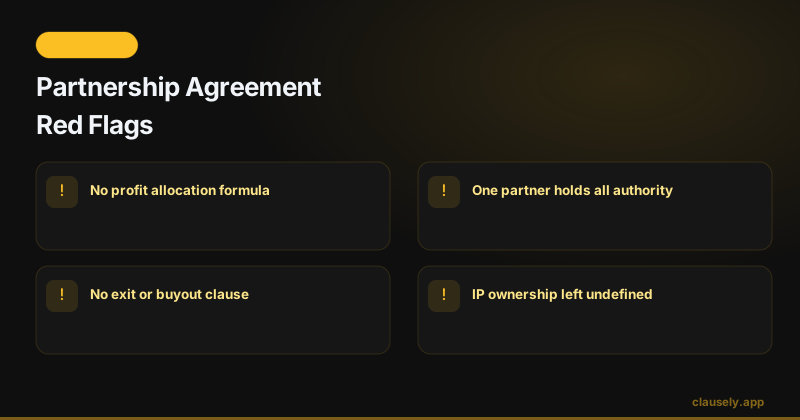
TL;DR: The most dangerous partnership agreements are not the ones full of complicated legal language. They are the ones that leave critical questions unanswered. Vague profit splits, missing exit clauses, and undefined decision-making authority are the partnership agreement red flags that destroy business relationships and personal finances.
Most business partnerships fail not because the people stopped working well together. They fail because the agreement was never clear about what would happen when they disagreed. A partnership agreement is the document that decides whether a business dispute becomes a recoverable problem or a legal catastrophe.
Before you sign, you need to know what to look for.
Partnership Agreement Risk Matrix
Use this table as your first pass. For each clause area, check whether your agreement matches the low-risk signal or the high-risk signal. Any high-risk signal should stop you before you sign.
| Clause Area | Low Risk Signal | High Risk Signal |
|---|---|---|
| Profit/loss allocation | Clearly defined percentages or formula | "To be determined" or silent |
| Decision-making authority | Defined voting rights and thresholds | One partner has absolute authority |
| Exit provisions | Clear buyout formula, timeline, and triggers | No exit clause or "must agree to exit" |
| Capital contributions | Specific amounts, timing, and consequences | Vague or aspirational |
| Dispute resolution | Defined process (mediation then arbitration) | Silent or "good faith only" |
| Non-compete post-exit | Time and geography limited | Indefinite or nationwide |
| IP ownership | Clearly assigned to the entity or named party | Vague "company owns everything" language |
| Personal liability | Limited liability entity structure confirmed | Partnership operates as general partnership by default |
If more than two of these columns land in the high-risk column, the agreement needs work before you commit.
Profit and Loss Allocation Disputes
Profit allocation is the most common flashpoint in business partnerships. The agreement should define exactly how profits and losses are split, not approximately.
Watch for these problems:
- Percentages are listed for profit but not for losses
- One partner takes a salary before the profit split, without defining what qualifies as a salary
- The agreement says profits are distributed "at the discretion of the managing partner"
- No language about retained earnings versus distributions
The phrase "to be determined" in a profit-sharing section is not a starting point. It is a future lawsuit. Disagreements about money are the most common reason partnerships dissolve, and they are the hardest to resolve without a pre-agreed formula.
The agreement should also address what happens if the business is not profitable. Who absorbs losses? In what proportion? Are partners required to make additional capital contributions to cover operating losses? If the agreement does not answer these questions, you are agreeing to figure it out later, under stress, without a framework.
Deadlock Provisions: What Happens When Partners Cannot Agree
A 50/50 partnership with no deadlock provision is a structural problem waiting to become a legal emergency.
Deadlock happens when partners hold equal voting weight and cannot reach a decision. Without a resolution mechanism built into the agreement, every major business decision can become a standoff. The business stops moving. Vendors do not get paid. Opportunities get missed. And no one can force a resolution without going to court.
A well-drafted partnership agreement addresses deadlock directly. Look for:
- A defined voting threshold for major decisions (simple majority, supermajority, or unanimous)
- A list of decisions that require unanimous consent versus majority vote
- A deadlock resolution mechanism, such as mediation, a neutral tiebreaker, or a forced buyout trigger
If the agreement gives one partner absolute authority to break ties, that is not a deadlock provision. That is one partner having final control over the business. You should know whether that is the structure before you sign, not after.
If you want to understand how arbitration clauses fit into a deadlock resolution process, that context matters here too.
Exit and Buyout Mechanics
The exit clause is the most important clause in a partnership agreement. It is also the one most likely to be missing entirely.
When a partnership ends, whether by choice or conflict, someone needs to be bought out or the business needs to be wound down. Without a predetermined process, that transaction becomes a negotiation between two parties who are already in disagreement.
A solid exit clause should include:
- A buyout formula, or a defined method for valuing the business at exit
- A payment timeline (how long does the buying partner have to pay?)
- The triggers that allow or require a buyout (death, disability, voluntary withdrawal, breach)
- What happens if neither partner can afford to buy the other out
Pay particular attention to language that says exit requires mutual agreement. That clause sounds reasonable until you want to leave and your partner does not want you to. "Must agree to exit" is functionally a trap. Either partner can be held in the business indefinitely.
The SBA business structure guide covers how different entity structures affect your exit options. General partnerships and LLCs operate differently, and your exit rights depend partly on which structure you chose.
For more on how buyout rights and related protective clauses work across contract types, see our guide on 7 clauses to check before signing any contract.
When One Partner Stops Contributing
One of the most painful partnership scenarios is when one partner checks out but refuses to leave.
You need the agreement to define what constitutes adequate contribution and what happens if a partner stops meeting that standard. This is sometimes called a "sweat equity" problem, and it is more common than most founders expect.
Look for language that addresses:
- Minimum time or effort commitments from each partner
- What constitutes a material breach of contribution obligations
- Whether a partner can be bought out or removed for non-performance
- How profit distributions are affected if one partner is not contributing
Without this language, a partner who does nothing can still claim their full ownership percentage. They cannot be removed without their consent, and they can block decisions you need to make. The agreement is the only place where you can pre-negotiate consequences for this situation, before it becomes personal.
You should also check the indemnification provisions. If one partner's actions cause a legal claim against the business, does the agreement address who is responsible for defending that claim and covering any resulting costs?
The IP Trap in Partnership Agreements
Intellectual property ownership is frequently mishandled in partnership agreements. The result can be that neither partner actually owns what they think they own.
The core problem is this: work created by a partner for the business may not automatically belong to the business. Depending on how the entity is structured and what the agreement says, IP may belong to the individual partner who created it, not the company.
This matters when:
- One partner exits and takes proprietary technology or systems with them
- The business is sold and the buyer discovers a key asset is not actually owned by the entity
- A former partner claims rights to software, branding, or content after they leave
A clear partnership agreement will:
- Assign all IP created in connection with the business to the entity, not the individual
- Include a work-for-hire clause or IP assignment clause covering future work
- Address pre-existing IP that a partner brings in, and define what the business does and does not own
Vague language like "the company owns everything related to the business" is not specific enough. Courts have found that ambiguous IP clauses leave ownership genuinely uncertain. You need explicit assignment, not a general principle.
Personal Liability in General Versus Limited Partnerships
This is the most financially dangerous area that founders routinely overlook.
Under US partnership law, a general partnership is the default structure when two or more people agree to operate a business together. General partners are personally liable for the debts and obligations of the partnership. That means a creditor can come after your personal bank account, your car, and your home, not just the business assets.
If you are operating as a general partnership, every partner carries unlimited personal liability for what every other partner does in the name of the business. One partner signs a bad contract. All partners are exposed. One partner makes a negligent decision. All partners can be sued personally.
The fix is entity structure, not just agreement language. Forming an LLC or limited partnership creates a legal separation between the business and the individuals. But the partnership agreement still needs to confirm which entity structure governs and how liability is allocated internally.
If your agreement is silent on entity structure and you have not formed a legal entity, you may already be operating as a general partnership by default, with full personal exposure. This is worth verifying before you go further.
The IRS partnership taxation page also covers how partnership income flows through to individual partners for tax purposes, which is a separate but related issue to understand before you commit to any structure.
Non-Compete Clauses After Exit
When a partner leaves, the remaining partners have a legitimate interest in making sure the departing partner does not immediately set up a competing business and take clients with them.
But non-compete clauses in partnership agreements can go too far, and courts in many states will not enforce them if they are unreasonably broad.
Red flags to watch for:
- No time limit on the non-compete (should be 1-2 years maximum in most contexts)
- Geographic scope is nationwide or global when the business operates locally
- The clause covers any business in the same industry, not just direct competition
- The non-compete applies even if the departing partner was bought out involuntarily
An enforceable non-compete is reasonable in scope, geography, and duration. An unenforceable one gives false security to the partner who stays and creates unnecessary risk for the partner who leaves. Either way, it is a sign the agreement was not carefully drafted.
If you are pushing back on a non-compete that seems unreasonable, see our guide on how to push back on a bad contract clause.
Getting a Partnership Agreement Reviewed Before You Sign
Reading a partnership agreement yourself and knowing what to look for are two different things. The risk matrix above will help you identify obvious problems. But the language that causes the most damage is often the language that sounds reasonable on a first read.
An AI contract review can flag high-risk clauses, identify missing provisions, and surface the language that deserves a closer look before you commit. It is not a replacement for a lawyer on high-stakes agreements, but it is a fast, affordable first pass that can tell you whether the agreement is in reasonable shape or needs significant work.
The structure of a partnership agreement determines what happens in the best case and the worst case. The time to negotiate it is before you sign, not after the relationship breaks down.
Frequently Asked Questions
What are the biggest red flags in a partnership agreement?
The most serious partnership agreement red flags are: no exit clause (or one that requires mutual consent to trigger), profit and loss allocation that is vague or silent, no deadlock provision in a 50/50 structure, and no IP assignment clause. Any one of these can cause permanent damage to both the business and the personal finances of everyone involved.
Do you need a lawyer to create a partnership agreement?
For any partnership involving significant money, shared assets, or long-term commitments, yes. A lawyer who specializes in business formation can catch problems that standard templates miss and make sure the agreement is enforceable in your state. For simpler arrangements, a reviewed template plus an AI contract review can serve as a starting point, but legal review is worth the cost when the stakes are real.
What happens if you operate a business without a partnership agreement?
If you operate as a business partnership without a written agreement, most states default to the Uniform Partnership Act or their own version of it. That means profits and losses are split equally regardless of contribution, all partners have equal management rights, and all general partners face unlimited personal liability. These defaults rarely match what either partner actually intended.
Are verbal partnership agreements legally enforceable?
In most US states, verbal partnership agreements can be legally binding, but they are extremely difficult to enforce because the terms are almost impossible to prove. Courts will often fall back on statutory defaults when the parties cannot agree on what was said. A written agreement is the only reliable way to document the terms both parties agreed to and to create a clear record if a dispute arises later.
Read the guide, then move into the real workflow, pricing, audience page, and glossary that support the next decision.
This article is for informational purposes only and does not constitute legal advice. For high-stakes agreements, consult a qualified attorney.
Got a contract to review?
Upload it and get full AI contract review in under a minute. Free.
Analyze My Contract