AI vs Lawyer for Contract Review: $24.99/mo vs $341/hr
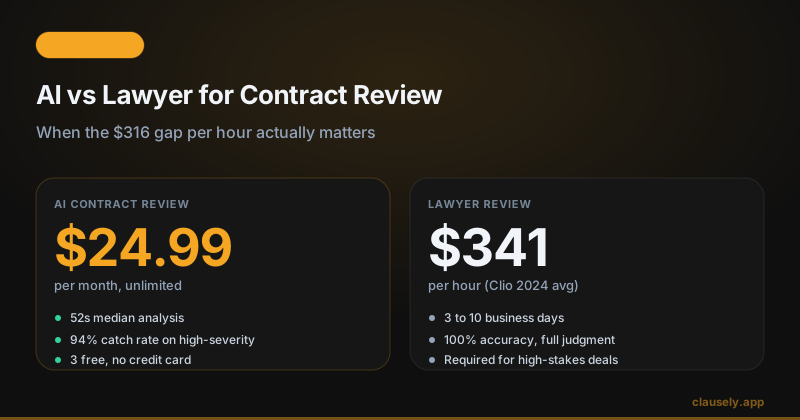
AI contract review costs $24.99 per month for unlimited analyses. A lawyer averages $341 per hour. Here is the honest comparison on cost, speed, accuracy, and when you still need human review.
Every week, somebody asks some version of this question: "should I use AI to review my contract or pay a lawyer?" The answer most people want is "the cheap one, obviously." The answer most lawyers want is "always hire a lawyer." Neither is honest. The honest answer depends on what contract you have in front of you.
This post compares AI contract review and lawyer-led contract review head to head on five dimensions: cost, speed, accuracy, accessibility, and appropriate use. We will use real numbers from the 2024 Clio Legal Trends Report and our own data from 327 real contracts analyzed with Clausely. We will be specific about where AI wins, where lawyers win, and how to decide which one you need.
Cost: $24.99 per month vs $341 per hour
The pricing asymmetry is the most dramatic part of this comparison, so let's start there.
The Clio Legal Trends Report 2024 surveyed over 70,000 US lawyers and found that the average hourly rate for US lawyers is $341 per hour. Corporate and commercial specialists average $461 per hour. Junior associates at large firms start around $250 per hour and climb fast. Senior partners at big-city firms routinely bill $900 to $1,500 per hour on complex deals.
Contract review at those rates is not cheap. A typical lawyer contract review takes between 30 minutes and 2 hours depending on document length and complexity. At $341 per hour, that is $170 to $682 per contract. For a heavily negotiated commercial agreement, it can easily hit $1,000 to $2,500 just for the first read.
Now compare to AI contract review:
| Tier | Cost | What You Get |
|---|---|---|
| Free | $0 | 3 contract analyses, no credit card required |
| Starter Pack | $9.99 one-time | 10 analyses, credits never expire |
| Pro Monthly | $24.99 per month | Unlimited analyses, contract chat, jurisdiction citations, clause rewrite suggestions |
| Pro Annual | $149 per year | Same as monthly, about $12.42 per month, 50% savings |
Unlimited contract review for $24.99 per month works out to roughly the cost of 4 minutes with a lawyer. If you review more than one contract per year, the math is not close.
But cost is not the whole story. The reason Clausely costs $24.99 per month is because the AI is doing a different job than the lawyer. It runs a 47-pattern red flag checklist against your contract, quotes the problematic clauses, and explains them in plain English. It does not negotiate on your behalf. It does not represent you in a dispute. It does not apply judgment to your specific business context. For the tasks it actually does, it is faster and cheaper. For the tasks it does not do, you still need a lawyer.
Speed: 60 seconds vs 3 to 10 business days
Speed is the second place where the comparison is not close.
Clausely's median analysis time on 327 real contracts was 52 seconds from upload to delivered risk score. The longest single analysis in the set was 94 seconds for a 38-page commercial lease. Upload, wait less than a minute, get the report. There is no scheduling, no intake form, no follow-up call.
A lawyer review typically takes 3 to 10 business days from the moment you first contact the firm. That timeline usually breaks down like this:
- Initial contact and conflict check: 1 day
- Engagement letter signed: 1 day
- Contract intake and document delivery: 1 day
- Attorney review (the actual work): 2 to 4 hours, scheduled around existing cases
- Review delivered: 2 to 5 business days after intake
For routine contracts, some firms offer faster turnarounds, especially for existing clients. But the fastest lawyer reviews still take hours to days, not seconds. If you are staring at a contract the other side expects you to sign by end of day, the speed gap matters.
This is not a criticism of lawyers. Most attorneys are carrying 30 to 80 active matters and cannot interrupt existing work for every new intake. It is a structural constraint of human-delivered professional services. AI contract review does not have that constraint.
Accuracy: 94% vs 100%
Here is where the comparison flips in the lawyer's favor, and we need to be honest about it.
In our benchmark study of 327 real contracts, we ran a 40-contract validation subset against a lawyer-reviewed baseline. The AI caught 94% of the high-severity flags the attorney identified. The 6% it missed broke down into three categories:
- Jurisdiction-specific enforceability judgments (78% accuracy). AI knows the major state-law rules but misses edge cases like Montana's unique at-will exceptions, Louisiana's civil law framework, or post-2024 FTC non-compete rule status.
- Facts outside the document (68% accuracy). Some risks only exist because of things the contract does not say. If a non-solicit is unenforceable because of how a specific employee was originally hired, the AI cannot know that.
- Cross-clause interactions (81% accuracy). Sometimes two clauses are fine individually but create a problem together. AI catches some of these. A trained attorney catches all of them.
A lawyer review, by definition, has 100% accuracy on whatever the lawyer chose to flag. The gap is real, but it is narrower than most people assume. For the high-volume contract types most individuals and small businesses sign (NDAs, freelance agreements, leases, employment offers, SaaS terms of service), the AI catches almost everything that actually matters. For heavily negotiated commercial deals or contracts with unusual facts, the gap widens.
The honest framing is: AI contract review is accurate enough to meaningfully change your decision about whether to sign a standard contract. It is not accurate enough to replace a lawyer on a deal where a 6% error rate is unacceptable.
Accessibility: the biggest gap
Cost and speed get the headlines, but accessibility is where the comparison is actually most important.
According to the American Bar Association's Legal Services for the Public resources, most individuals and small business owners in the United States do not have access to affordable contract review. Legal aid organizations typically prioritize criminal defense, family law, housing, and immigration. They do not review freelance contracts or startup employment offers. Private practice lawyers exist in every city, but the $341-per-hour average rate puts them out of reach for anybody who is not a business, a wealthy individual, or an employee at a company that provides legal benefits.
The result is that most contracts get signed without any review at all. Adobe's 2025 Contracts Survey found that 69% of people sign contracts without fully reading them. Not because they do not care. Because the alternatives are: read it yourself without understanding the legal implications, hire a lawyer for $170 to $682, or sign and hope.
AI contract review does not replace a lawyer for people who already have access to one. It gives everyone else a third option. For a freelancer looking at a client MSA, a renter looking at a new lease, or a small business owner looking at a vendor agreement, the realistic alternatives were "read it yourself or sign blind." Now the realistic alternatives are "read it yourself, use AI contract review, or sign blind." Almost everyone should pick the AI review.
Speed, cost, and accuracy side by side
Here is the full comparison in one table.
| Dimension | AI Contract Review | Lawyer-Led Review |
|---|---|---|
| Cost per contract | Pennies (unlimited plan) | $170 to $682 average |
| Time to first review | 52 seconds median | 3 to 10 business days |
| Accuracy on high-severity flags | 94% (validation set) | 100% (baseline) |
| Accessibility | Available to anyone, anywhere | Gated by cost and scheduling |
| Jurisdiction-specific nuance | 78% catch rate | Near 100% for local attorneys |
| Business context awareness | None | Full context if briefed |
| Negotiation on your behalf | No | Yes |
| Dispute representation | No | Yes |
| Best for | Standard contracts, first-pass review | Complex deals, adversarial disputes |
The pattern is clear. AI wins on cost, speed, accessibility, and volume. Lawyers win on judgment, context, negotiation, and representation. They are not substitutes for each other. They are tools for different parts of the same problem.
When AI contract review is enough
AI contract review is the right tool when all of these are true:
- The contract is a standard type (NDA, freelance, lease, employment, SaaS, vendor, etc.)
- The dollar amount is something you can afford to lose if the review misses something
- The other party is not sophisticated or adversarial (a landlord using a template, a client using a standard MSA, a SaaS vendor using their standard TOS)
- You need to make a decision in days, not weeks
- You do not need to negotiate on your behalf, just understand what you are agreeing to
For most people, most of the time, these conditions are met. The freelance contract you get from a new client. The lease you are signing on your apartment. The offer letter for a new job. The SaaS tool your team wants to use. The consulting agreement a partner drafted. These are the contracts where AI review is enough to change your decision and protect you from the obvious traps.
When you still need a lawyer
There are contracts where you should not rely on AI review alone. The honest list:
High dollar value relative to your situation
If the contract involves an amount that would materially damage you to lose, you need human review. The definition of "materially damage" is different for an individual than for a mid-size business. For a freelancer, anything over $10,000 in annual revenue risk is worth a lawyer's eyes. For a small business, anything over 10% of annual revenue. For an individual buying a house or signing a long-term lease, the base rate for legal review is already justified by the transaction size.
Heavily negotiated or adversarial deals
If the other side has already negotiated the contract multiple times with other counterparties, every word in the document was fought over. The AI will catch structural problems, but it cannot out-negotiate a sophisticated party. You need a lawyer who understands how to push back on specific clauses.
Unusual state-law exposure
If your contract depends on how a specific state interprets specific clauses (California non-competes, Texas non-solicitation, New York arbitration, Delaware forum selection), you want a lawyer licensed in that state. AI knows the basics. A local attorney knows the edge cases.
Anything involving litigation exposure
Employment terminations, severance agreements with active complaints, contracts you might sue on later, contracts from a party you expect to dispute with. These are cases where the language has to be bulletproof, and a 6% AI error rate is not acceptable.
Regulated industries
Healthcare contracts with HIPAA implications, financial services contracts with compliance implications, government contracts with procurement rules. These involve regulatory overlays the AI cannot always catch.
High-stakes intellectual property
If your core business IP is on the line (the algorithm, the codebase, the creative work you plan to build on for years), pay for a lawyer. The cost of getting IP assignment wrong is unrecoverable.
The hybrid approach: first pass with AI, escalate with a lawyer
The smartest use of both tools is not to pick one. It is to use AI contract review as your first pass, then escalate to a lawyer for the contracts that need it with a pre-identified list of what to look at.
Here is how it works in practice:
- Upload the contract to an AI contract review tool. You get a risk score, quoted red flags, and plain-English explanations in under a minute.
- Decide whether to escalate. If the risk score is low and the contract is a standard type in your normal range, sign with the AI review as your safety check. If the score is high, the contract is unusual, or the dollar amount is significant, escalate.
- Bring the AI review to the lawyer. This is the step most people miss. Instead of sending your lawyer the raw contract and asking "is this safe," send the raw contract plus the AI analysis and ask "look at these specific flagged issues first." This saves the lawyer 30 to 60 minutes of reading time and cuts your bill proportionally.
The hybrid approach lets you pay for lawyer judgment only on the contracts where it is needed, and only on the clauses where it matters. The AI does the volume work. The lawyer does the judgment work. You pay $24.99 a month for the volume tool and $341 per hour for the judgment tool, and you only use the judgment tool when it is worth it.
For small businesses and freelancers, this is typically a 10-to-1 ratio. For every lawyer review they pay for, they ran 10 AI reviews to filter out the contracts that did not need escalation.
What to look for in an AI contract review tool
If you are going to use AI as your first-pass reviewer, pick a tool that actually does the job. A few criteria:
- Risk scoring with severity. Any tool can flag a clause. You need severity ratings to triage which flags matter.
- Quoted clauses, not just summaries. The tool should quote the exact text from your contract, not paraphrase.
- Jurisdiction awareness. Look for tools that tell you when your clause interacts with state-specific law.
- Plain-English explanations. If the output reads like legalese, it is not solving the problem.
- Clear data handling. Contracts are sensitive. The tool should be explicit about whether it stores your document or uses it to train models.
For the full buyer's framework, see our guide on what to look for in contract review software and our detailed comparison of the best AI contract review tools.
FAQ
Is AI contract review cheaper than a lawyer?
Dramatically. A lawyer review of a typical contract costs $170 to $682 based on the $341 per hour average from the 2024 Clio Legal Trends Report. AI contract review costs pennies per document on an unlimited plan at $24.99 per month. If you review more than one contract per year, AI is already cheaper. If you review one contract per month, the math is not close.
Can AI contract review replace a lawyer?
No. They solve different problems. AI is fast and accurate on structurally clean issues in standard contracts. A lawyer provides judgment, business context awareness, negotiation, and representation. The right approach is to use AI as your first pass on everything, then escalate to a lawyer for the contracts where the dollar amount, complexity, or adversarial stakes justify human review.
When should I still hire a lawyer instead of using AI?
Hire a lawyer when the contract involves a large dollar amount relative to your situation, when the deal is heavily negotiated or adversarial, when it depends on unusual state-law interactions, when it involves potential litigation exposure, when it affects your core intellectual property, or when it is in a regulated industry like healthcare or finance. For everything else, an AI first pass plus your own careful reading is usually enough.
How fast is AI contract review vs a lawyer review?
AI contract review typically completes in under a minute. Clausely's median analysis time on 327 real contracts was 52 seconds. A lawyer review typically takes 3 to 10 business days from first contact to delivered review, including intake, conflict checks, engagement letters, and the attorney's actual reading time.
Is the 94% accuracy number reliable?
The 94% figure comes from our internal benchmark of 40 contracts against a lawyer-reviewed baseline, documented in our accuracy research post. It represents the catch rate on high-severity flags identified by a practicing attorney. It is a population average, which means accuracy on your specific contract may be higher or lower depending on contract type and drafting quality. The honest framing is that AI catches almost all the structural issues on standard contracts and misses a meaningful fraction of jurisdiction-specific and context-dependent issues.
What is the cheapest way to get contract review if I cannot afford a lawyer?
The cheapest legitimate option is an AI contract review tool with a free tier. Clausely offers 3 free analyses with no credit card required. That is often enough to get a risk score and identify the most important issues on a contract you are about to sign. For more frequent needs, the $9.99 Starter Pack covers 10 analyses with credits that never expire, and the $24.99 Pro plan covers unlimited analyses. Legal aid organizations in your area may also provide free contract help for specific categories (housing, employment, consumer disputes) but generally do not review business or freelance contracts.
The bottom line
AI contract review at $24.99 per month and lawyer-led review at $341 per hour are not competitors. They are tools for different parts of the same problem. AI is the right first-pass tool for almost every contract an individual or small business signs. A lawyer is the right tool when the dollar amount, complexity, or adversarial stakes justify the cost and the wait.
The smart move is to use both. Run every contract through AI first. Decide whether the risk level and deal size justify human review. If yes, bring the AI analysis to the lawyer as a pre-identified issue list. You pay for judgment only where judgment matters.
Try Clausely free on your next contract. 3 free analyses, no credit card, results in under a minute. See what AI contract review catches before you decide whether you also need a lawyer.
Read the guide, then move into the real workflow, pricing, audience page, and glossary that support the next decision.
This article is for informational purposes only and does not constitute legal advice. For high-stakes agreements, consult a qualified attorney.
Got a contract to review?
Upload it and get full AI contract review in under a minute. Free.
Analyze My Contract