Severance Agreement Review: What to Check Before You Sign
Severance agreement review checklist: what to look for in your package, release of claims, non-compete, ADEA rights, and when to push back.
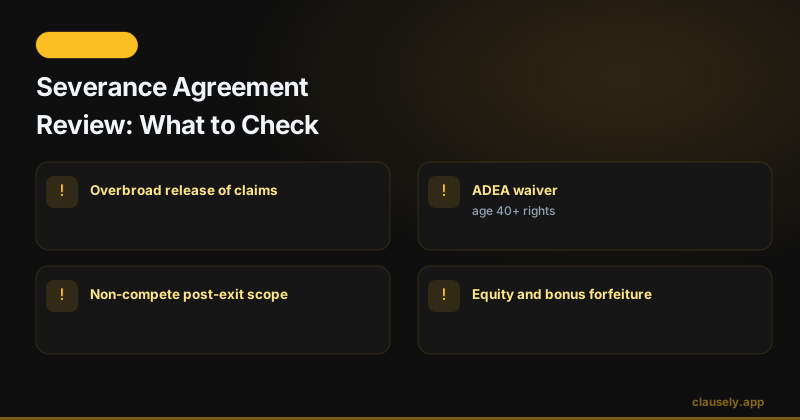
You have been handed a severance agreement. HR is waiting. Your last day is already decided. And the document in front of you is asking you to give up legal rights in exchange for a payment.
Most people sign within days without understanding what they are waiving. That is exactly what the agreement is designed for. The good news: you have more time than you think, and more leverage than it feels like right now.
Most severance agreements come with a 21-day review window. If the layoff is part of a group reduction of 2 or more employees, that window extends to 45 days. That clock starts the moment you receive the document. What you do with that time matters.
Start here.
The Severance Agreement Review Checklist
Before reading a single line of the fine print, scan these 8 sections. They cover the highest-risk areas in any severance agreement.
| Section | What to Check | Red Flag to Watch For |
|---|---|---|
| 1. Severance amount and payment schedule | Total payout, how it is structured, when you get paid | Less than 1 to 2 weeks per year of service for your level; payment delayed beyond 30 days |
| 2. Release of claims | Which legal claims you are giving up | Overly broad release; ADEA waiver if you are 40+; no carve-outs for pending workers' comp or unemployment claims |
| 3. Non-disparagement clause | Whether you can talk about your experience | One-sided language where only you are restricted; company retains right to say what they want about you |
| 4. Non-compete and non-solicitation | Restrictions on your next job or your clients | Geographic scope that would block your career; long duration (12+ months); covers clients you brought in |
| 5. Benefits continuation | Last date of health coverage and COBRA options | COBRA info missing; no clarity on when benefits end; no mention of accrued PTO payout |
| 6. Equity and bonus treatment | What happens to unvested stock and pending bonuses | Unvested options forfeited with no acceleration language; bonus for a completed period not addressed |
| 7. References and departure characterization | What your employer will say and in writing | No written reference agreement; vague language on reason for departure in future verifications |
| 8. Cooperation clause | Whether you must assist in future legal matters | Open-ended obligation with no time limit; no reimbursement for your time or legal costs |
If any of these sections is vague, one-sided, or missing, you have grounds to negotiate before you sign.
Release of Claims: The Most Important Section
The release of claims is the core of every severance agreement. It is the reason the company is paying you anything. In exchange for the severance, you agree not to sue them.
The question is: what exactly are you agreeing not to sue them for?
A narrow, reasonable release covers claims related to your employment and termination. An overbroad release tries to cover things like:
- Discrimination claims you may not even know about yet
- Wage and hour violations
- Claims related to workplace injuries
- Future claims that arise after you sign
Watch for language like "any and all claims, known or unknown, arising out of or related to your employment." That phrase is doing a lot of work. It can extinguish rights you did not know you had.
Look for carve-outs. A fair agreement will exclude claims for workers' compensation, unemployment benefits, vested retirement benefits, and any rights that cannot legally be waived. If those carve-outs are not there, ask for them.
Also check: does the release run both ways? Some agreements only restrict you. Others include a mutual release where the company also agrees not to assert certain claims against you. That is worth asking for.
ADEA Rights If You Are 40 or Older
If you are 40 years of age or older, federal law gives you specific protections that the company cannot take away. The Older Workers Benefit Protection Act (OWBPA) sets strict requirements for any waiver of Age Discrimination in Employment Act (ADEA) rights.
Under those requirements, any valid ADEA waiver must:
- Be written in plain language you can understand
- Specifically reference ADEA rights
- Not waive rights that arise after the agreement is signed
- Be accompanied by something of value beyond what you were already entitled to
- Give you at least 21 days to consider the agreement (45 days in a group layoff)
- Give you 7 days to revoke after signing, even after you have already agreed
That 7-day revocation window is non-negotiable. Even if you sign on day 1, you can change your mind up until day 8. The agreement is not final until that window closes.
If the agreement does not include these elements, the ADEA waiver is not enforceable. You can learn more about these requirements directly from the EEOC's guidance on waivers of discrimination claims in employee severance agreements.
In group layoffs, companies must also provide a list of the employees selected for the reduction and those who were not, along with the selection criteria and eligibility factors. If you were laid off as part of a group and did not receive that information, ask for it in writing.
Non-Compete and Non-Solicitation Clauses
Many severance agreements include non-compete or non-solicitation provisions. These clauses can directly affect your ability to earn a living after you leave.
A non-compete restricts you from working for competitors or starting a competing business for a defined period and within a defined geography. A non-solicitation clause restricts you from reaching out to your former employer's clients or employees.
Before accepting these restrictions, check:
Duration. Anything beyond 6 to 12 months deserves scrutiny. The longer the restriction, the more it should cost the company to enforce it.
Geographic scope. A nationwide non-compete for a regional role is often unenforceable, but you may still spend money fighting it if you ever violate it.
Definition of "competitive." If the definition is broad enough, almost any new employer could technically qualify. Read it carefully.
Client relationships you built. If you sourced the client yourself, a non-solicitation clause that prevents contact with that client may not be enforceable. That depends on your state.
Non-compete enforceability varies significantly by state. California, Minnesota, and North Dakota ban most non-competes outright. Other states enforce them if they meet certain criteria. If you are in a state with strong protections, you may be signing something that would not hold up in court anyway.
You can still ask to narrow or remove these provisions even if they appear to be standard.
Equity and Bonus Treatment
If you have unvested stock options, RSUs, or a bonus pending, the severance agreement is your last opportunity to negotiate how those are handled. Once you sign, your leverage disappears.
Check each of the following:
Unvested equity. The default treatment is forfeiture. If you were close to a vesting cliff, ask whether the company will accelerate vesting as part of the severance terms. This happens more often than most employees realize, particularly at the director level and above.
Pending bonus. If you completed a quarter or fiscal year and a bonus was expected, get clarity on whether it will be paid. If the agreement is silent on your bonus, raise it before signing. Silence does not protect you.
Exercise window for options. If you have vested stock options, your agreement should specify how long you have to exercise them after your last day. The standard is 90 days, but some agreements allow for extended windows, particularly if you were laid off rather than terminated for cause.
Grant agreements. Your severance agreement may reference your original equity grant agreements by name. Pull those documents. The severance agreement may not override all of the original terms, and the grant agreement could include provisions that help you.
COBRA and Benefits Continuation
Your health insurance ends on a specific date. You need to know that date before you can make decisions about COBRA enrollment.
COBRA allows you to continue your existing employer-sponsored health coverage for up to 18 months, but you pay the full premium, including the portion your employer was covering. That is often a significant increase from what you paid while employed.
The Department of Labor's COBRA resource page covers your rights and the election timeline in detail. You have 60 days from losing coverage to elect COBRA, but your coverage gaps during that window can create complications with ongoing care.
Your severance agreement should clearly state:
- Your last day of employer-covered benefits
- Whether the company will cover any portion of COBRA premiums as part of severance
- How accrued and unused PTO will be treated
If any of these are missing, add them to your negotiation list.
Indemnification and the Cooperation Clause
The cooperation clause appears near the end of most severance agreements and is frequently overlooked. It typically requires you to assist your former employer in future legal matters, regulatory inquiries, or litigation.
On the surface that sounds reasonable. The problem is the scope.
Open-ended cooperation clauses can require you to take time off from a new job, prepare for depositions, review documents, or participate in proceedings for months or years after you leave. Some agreements include language requiring this assistance at your own expense.
Ask for:
- A time limit on your cooperation obligation (12 to 24 months is reasonable)
- Reimbursement for out-of-pocket costs, including legal fees if you need your own counsel
- Reasonable notice requirements so you are not called on with 24 hours' notice
Also review any indemnification language. Some agreements include provisions that hold you responsible for costs arising from your actions during employment. Make sure those obligations are clearly scoped to actions taken in bad faith or outside your role, not routine business decisions.
Negotiating the Agreement
Receiving a severance offer does not mean it is final. Most companies build negotiation room into the initial offer, especially at the manager level and above.
What you can reasonably push for:
- Higher severance amount (1 to 2 weeks per year of service is common; senior roles often command more)
- Extension of benefits coverage before COBRA kicks in
- Outplacement services or a career transition budget
- Removal or narrowing of the non-compete
- A written positive reference agreement
- Acceleration of vested equity or clarity on pending bonus
The key is to negotiate in writing and to do it before you sign. Once you sign the release, the discussion is over.
If you are uncertain where to push back, Clausely can walk you through the specific language in your agreement and flag the terms that carry the highest risk. You can review your severance agreement with AI contract review without uploading sensitive documents to a general-purpose tool.
For a broader look at how to handle difficult contract language before signing, see the guide on how to push back on a bad contract clause.
You should also review what to do before signing an employment offer, since many of the same protections apply at both ends of the employment relationship.
For a broader overview of what severance pay covers legally, Cornell Law School's Legal Information Institute has a clear summary of how courts and regulators approach it.
Frequently Asked Questions
How long do I have to review a severance agreement?
For most employees, the minimum review period is 21 days from the date you receive the agreement. If the layoff is part of a group reduction involving 2 or more employees, the review period extends to 45 days. These timelines apply specifically to ADEA waivers for employees 40 and older, but many companies apply the same standard regardless of age. You also have 7 days after signing to revoke your signature, and the agreement is not enforceable until that revocation period ends.
Can I negotiate a severance agreement?
Yes. Most severance offers are not final on delivery. The company has already decided to part ways with you, which means their leverage is limited. You can negotiate the severance amount, benefits coverage, non-compete scope, reference terms, and treatment of equity or bonuses. The strongest position is to negotiate before you sign. Once you sign and the revocation period passes, your ability to revisit the terms is gone.
What does a release of claims mean in a severance agreement?
A release of claims is a legal waiver. By signing it, you agree to give up your right to sue the company for specific categories of claims. This typically includes discrimination claims, wrongful termination claims, and wage disputes. Some releases are narrow and well-defined. Others are written broadly enough to waive rights you may not be aware of. You should know exactly what you are releasing before you agree to it. A release that covers "all claims, known or unknown" is worth scrutinizing closely.
Do I need a lawyer to review a severance agreement?
Not always, but it depends on the size of the package and the complexity of the terms. If your severance involves equity, a pending lawsuit, or post-employment restrictions that could affect your career, consulting an employment attorney is worth the cost. Many employment attorneys offer a flat-fee document review for severance agreements. If your situation is more straightforward, an AI contract review tool can help you identify the key terms and flag anything unusual before you decide whether to escalate to legal counsel.
Read the guide, then move into the real workflow, pricing, audience page, and glossary that support the next decision.
This article is for informational purposes only and does not constitute legal advice. For high-stakes agreements, consult a qualified attorney.
Got a contract to review?
Upload it and get full AI contract review in under a minute. Free.
Analyze My Contract