Scope Creep Clauses: How to Spot Them in Freelance Contracts
Learn how scope creep clauses in freelance contracts drain your time and income, with real before/after clause examples and how to fix each one.
TL;DR: The most common way freelancers lose money is not low rates. It is agreements where the scope never ends. Scope creep is often not accidental. It is enabled by vague contract language that makes extra work seem included. This post shows you the exact clause patterns to watch for and how to rewrite them before you sign.
Scope creep rarely announces itself. A client asks for one more revision. Then one more change. Then a completely different deliverable than what was agreed. And when you go back to the contract, it reads like all of it was always included.
That is not bad luck. That is a weak contract doing exactly what weak contracts do.
Understanding freelance contract red flags is important. But scope creep deserves its own focus because it works differently. It is not one single bad clause. It is several contract weaknesses working together to leave your time unprotected.
What Is a Scope Creep Clause?
A scope creep clause is not an official legal term. It is a shorthand for any contract language that leaves the scope of work open-ended enough that clients can expand it without triggering additional payment.
According to Cornell Law School's Legal Information Institute, a valid contract requires clear offer, acceptance, and consideration. When the deliverables are not clearly defined, what you agreed to do becomes a moving target.
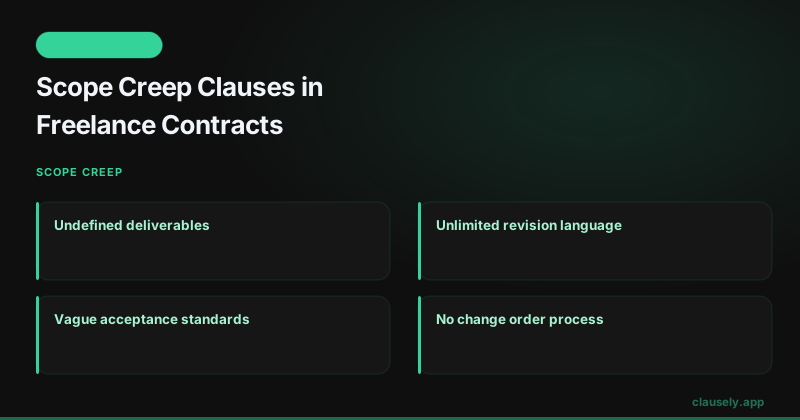
Scope creep in freelance contracts is usually enabled by five specific weaknesses:
- Undefined deliverables
- Unlimited or vague revision language
- Acceptance language tied to subjective client satisfaction
- No process for handling change requests
- Payment tied to vague or open-ended milestones
Each of these can be fixed before you sign. The key is knowing what to look for.
5 Clause Patterns That Enable Scope Creep
1. Undefined Deliverables
This is the most common entry point for scope creep. When a contract describes work in general terms, clients fill in the blanks with whatever they need at the time.
Weak language:
"Contractor will design marketing materials as needed."
The phrase "as needed" is the problem. It converts a fixed scope into an open request queue. Every new asset the client thinks of becomes something you are already contracted to deliver.
Stronger language:
"Contractor will design 3 social media graphics (1080x1080px) and 1 email header (600px wide) per the attached creative brief. Any additional assets are not included in this agreement and require a separate written agreement or change order."
The stronger version names the exact outputs, specifies dimensions, references a brief that locks the concept, and explicitly excludes anything not listed.
When reviewing a contract, search for phrases like "as needed," "and similar work," "other tasks as requested," or "additional support." These are flags. Replace them with numbered lists of specific deliverables.
2. Unlimited Revisions
Revision language is one of the most expensive areas of a freelance contract. Clients tend to treat unlimited revisions as a design subscription. One project can turn into months of back-and-forth without ever hitting a defined end point.
Weak language:
"Client may request revisions until satisfied."
There is no limit. There is no cost for additional rounds. Satisfaction is entirely subjective. This clause makes it impossible to close the project without client sign-off on no defined timeline.
Stronger language:
"Two rounds of revisions are included in this agreement. A revision round is defined as a consolidated list of changes submitted in a single communication. Additional revision rounds are billed at $[rate] per hour, invoiced at the end of each round."
The stronger version defines what a round means, sets a numerical limit, prices additional rounds, and establishes a billing process. This protects your time without making you seem difficult. It just makes the rules clear upfront.
If a client pushes back on revision limits, that is useful information. It tells you they expect extensive changes before it ever starts. You can negotiate, but you should also price accordingly.
3. Vague Acceptance Language
Approval and acceptance language controls when a project is legally complete. If that language ties completion to client satisfaction without a deadline or standard, you can finish the work and still not be "done" in the eyes of the contract.
Weak language:
"Work is complete when the client approves."
This has no timeline. No definition of what approval looks like. No consequence for a client who simply never responds or keeps requesting changes under the guise of "not approving yet."
Stronger language:
"Work is deemed accepted if no written objections are received within 5 business days of delivery. Approval will not be unreasonably withheld. Objections must be specific and related to the original scope."
The stronger version creates a deemed-acceptance mechanism. Silence becomes approval after a defined window. This is a standard commercial contract device. It is not aggressive. It is just professional.
The phrase "unreasonably withheld" is also important. It sets a standard that prevents clients from rejecting acceptable work without cause.
4. No Change Order Process
Even well-scoped projects evolve. Clients legitimately need to add things. The problem is when the contract has no formal process for handling those additions. Without a change order requirement, every addition becomes a verbal agreement with no price attached.
Weak language:
"Client may request changes at any time."
This clause sounds reasonable. It is not. It means any request becomes part of your obligation. There is no requirement for the client to document what they want, agree to a cost, or wait for your approval before work begins.
Stronger language:
"Material changes to the scope require a written change order specifying the additional deliverables, timeline, and fee. Work on any change will not begin until the change order is signed by both parties."
The stronger version creates a documented approval cycle. It makes scope changes formal. That formality is not a bureaucratic burden. It protects both sides by making the rules explicit before money or time is spent.
If you want to learn how to negotiate individual clauses like this one, see our guide on how to push back on a bad contract clause.
5. Payment Tied to Vague Milestones
Payment structures that connect money to undefined project states create leverage for clients to withhold payment. If the contract says "final payment due at project completion" but completion is tied to client approval, then completion is entirely under client control.
Weak language:
"Final payment due at project completion."
Combine this with a vague acceptance clause and you have a project that can theoretically never reach completion. The client keeps requesting changes. You keep making them. Payment stays pending.
Stronger language:
"50% due on project start, invoiced on the date this agreement is signed. 50% due within 7 days of final file delivery, regardless of client approval status."
The stronger version decouples final payment from client approval. Delivery triggers the invoice. You retain the work files until payment clears, which gives you leverage without being adversarial.
For a deeper look at payment structures, read our guide on how to negotiate payment terms in a freelance contract.
How to Negotiate These Clauses
Most clients do not write these contracts to exploit you. They copy templates they found online or reuse agreements from past projects without thinking through the implications. That means most of these clauses can be negotiated without conflict if you frame the conversation correctly.
A few principles that help:
Normalize the ask. Frame your edits as standard professional practice. "I structure all my contracts this way" removes the sense that you are singling out the client.
Offer a simple explanation. "Two revision rounds is enough time to get this right. After that, changes are billed hourly" is clear and fair. You do not need to explain in detail. Just be direct.
Document every conversation. If a client verbally agrees to something during negotiation, put it in writing before work starts. Email confirmation is enough. Verbal agreements about scope are almost impossible to enforce later.
The Freelancers Union publishes resources on contract negotiation for independent workers and recommends always reviewing scope and payment terms before signing anything.
What to Do When Scope Creep Happens Mid-Project
Even strong contracts do not prevent every scope conversation. Sometimes a client genuinely does not realize they are asking for something new. Sometimes they are testing what they can get.
Either way, the process is the same.
Step 1: Pause before responding. Do not just say yes. When a client asks for something new, take a moment. Review the contract. Confirm whether it is in scope or not.
Step 2: Acknowledge the request. Something like: "That sounds like a great addition. Let me check whether that falls within the current scope."
Step 3: Document what happened. Even if you decide to absorb a small request, send an email noting that you did it as a courtesy and that future additions will require a change order. This establishes the pattern.
Step 4: Issue a change order for anything material. Use a simple template. Describe the new deliverable, the additional time required, the price, and the revised timeline. Ask for written sign-off before starting.
Step 5: Track everything. Keep a log of every request, every change, and every decision. If a dispute develops later, this documentation is your evidence.
The IRS guidance on independent contractor status emphasizes that contractors control how and when work is done. Documenting your process reinforces that relationship.
How to Document Scope in Real Time
The best freelancers treat scope documentation as an ongoing task, not a one-time setup.
A few habits that help:
Send a scope confirmation email at the start of every project. List the agreed deliverables, revision rounds, timeline, and payment schedule. Ask the client to reply confirming they agree. This creates a written record outside the contract.
Date-stamp every delivery. When you send work, note the date in your email. This protects you if acceptance timing ever becomes an issue.
Keep a running change log. When anything shifts, even informally, note it. A simple spreadsheet or text file with dates and descriptions is enough.
Send a wrap-up email at the end of every project. Confirm that the agreed deliverables have been completed, that the project is now closed, and that further work requires a new agreement. This creates a clear endpoint.
Using a tool that helps you review your freelance contracts before signing can catch scope-related weaknesses before work even begins. Running a quick analysis on any new contract is faster than fixing a scope dispute three weeks into a project.
See our full breakdown of how Clausely works for freelancers specifically to understand which clause patterns the tool flags automatically.
Frequently Asked Questions
What does scope creep mean in a contract?
Scope creep in a contract refers to the gradual expansion of a project beyond what was originally agreed to, usually because the contract uses vague language that does not clearly define what is and is not included. It is rarely one big demand. It is usually a series of small additions that accumulate over time, each one seeming reasonable on its own.
How do you prevent scope creep in a freelance contract?
Prevention starts before you sign. Define deliverables with specifics: quantities, formats, and references to a creative brief or project document. Set a numerical limit on revision rounds. Include a formal change order process that requires written sign-off before any new work begins. Tie payment to delivery dates rather than client approval. And send a scope confirmation email at the start of every project.
What should you do when a client pushes for work outside the agreed scope?
Stop before responding. Review the contract to confirm whether the request is in scope. If it is not, acknowledge the request, explain that it falls outside the current agreement, and offer to issue a change order with a price and timeline. Keep the tone matter-of-fact. You are not refusing to help. You are following the agreement both parties signed.
Can you invoice for out-of-scope work even if you already completed it?
It depends on whether you have a change order or written confirmation that the client agreed to pay for it. Completing out-of-scope work without a documented agreement puts you at risk of non-payment. If the work is already done, send a change order retroactively with a clear description of what was completed and what the charge is. In future projects, issue the change order before starting any work that is not in the original scope.
Read the guide, then move into the real workflow, pricing, audience page, and glossary that support the next decision.
This article is for informational purposes only and does not constitute legal advice. For high-stakes agreements, consult a qualified attorney.
Got a contract to review?
Upload it and get full AI contract review in under a minute. Free.
Analyze My Contract